
Deadwood — a detailed slot review with bonus buy and aggressive volatility (2026)
Deadwood is a high-volatility video slot from Nolimit City that still feels “modern” in 2026 because its core mechanics push risk and reward harder than most western-themed titles. The game is built around xNudge multiplier wilds, two selectable free-spins modes, and an upgrade path that can turn a normal bonus into a far more intense session. It also includes a feature-buy option in many markets, which changes how players approach bankroll and variance. This review focuses on the actual mechanics, what they mean for outcomes, and what to check before you place real money spins.
Key facts you should verify before playing for real money
Start with the fundamentals, because Deadwood is not a “casual spins” slot. The base RTP is commonly listed at 96.03%, but Nolimit City titles are often distributed with multiple RTP configurations, meaning the percentage can vary by operator and jurisdiction. In practical terms, two people playing “the same slot” in different countries can be playing slightly different maths, which matters in a high-variance game where long losing stretches are normal.
The game’s maximum win is widely reported as 13,950x the stake, and the release sits in the 2020 timeframe, with Deadwood remaining a popular reference point for Nolimit City’s xNudge style. It uses a 5-reel layout with variable rows (commonly shown as 3-4-4-4-3) and a ways-to-win structure that is often listed as 576 ways. None of these specs guarantee frequent wins; they simply define how wins can form when the slot decides to pay.
Also note the operational limits: minimum and maximum bets differ by casino, and some regulated markets remove feature buys or other “instant entry” options. If you are choosing a site purely because you want the bonus buy, confirm it exists in your lobby, because the provider can disable it depending on local rules. A quick check in the game menu usually saves time and avoids wrong expectations.
How Deadwood’s “aggressive volatility” shows up in real sessions
Deadwood’s volatility isn’t just a label; it’s felt in pacing. You can see clusters of dead spins, short teases (like partial bonus symbols), and then sudden spikes where a single wild or badge interaction changes the entire outcome. That profile can be entertaining, but it also makes it easy to misread results, especially if you switch between very small and very large bet sizes.
One reason the swings feel sharp is that the game’s biggest moments tend to come from bonus interactions rather than routine line hits. In the base game you might get modest payouts, but the “story” is really about how the modifiers stack and when the slot decides to place wilds in positions that matter. A session can look flat for a long time and still end with one bonus that defines the balance curve.
If you are evaluating Deadwood responsibly, treat it like a slot designed for long, uneven stretches. That means planning a stop-loss, avoiding chasing after near-misses, and keeping your stake consistent enough to judge the slot fairly. In high-variance titles, constantly changing the bet often makes the player’s result feel more chaotic than the game itself.
Core mechanics: xNudge wilds, badges and the base-game pressure points
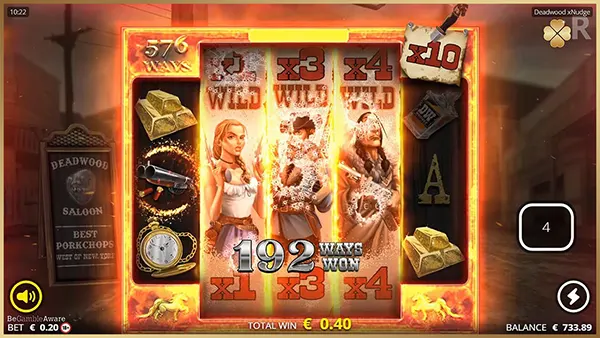
Deadwood’s signature mechanic is the xNudge multiplier wild. The idea is simple: a tall wild can land partially visible, then “nudge” into full view, and each nudge increases its multiplier. When this lands in a useful spot, it can convert an ordinary line win into something meaningful, particularly if more than one multiplier wild contributes to the same evaluation.
The Sheriff badge symbols are the second pillar. When you see badges appear on the right reels, the game can shift from standard symbol evaluation into a feature-like moment where low-value symbols on the middle reels can transform into wilds (the Shoot Out behaviour). Even without triggering a full bonus, these moments create most of the base-game excitement, because they can turn a dull spin into an event.
Deadwood’s base game can feel “tight” if you’re used to low-volatility slots that pay small amounts often. Here, the base is frequently just a runway for larger events, and it’s normal to see many spins where nothing meaningful happens. The most practical approach is to see the base as your cost of access to bonus potential, not as the place where the slot “should” pay you back steadily.
What to look for on the reels when you’re assessing value
Watch how often the game places the tall wilds in positions that can actually connect winning combinations. A multiplier wild that lands but cannot help complete a line is still part of the game’s volatility design: it creates anticipation without necessarily paying. Over time, you’ll notice that the best swings come when wild placement and symbol alignment cooperate on the same spin.
Badge behaviour is also a useful indicator. When the slot starts highlighting or changing symbol sets around the middle reels, you’re usually close to a feature-like outcome even if it doesn’t fully “convert.” That teasing is common in this title, and it’s one reason players overestimate how soon a bonus will arrive.
Finally, remember that “ways” does not equal “easy wins.” With a ways-to-win structure, you still need matching symbols from left to right, and Deadwood can simply refuse to provide the alignment that matters. If you want a steadier baseline, this slot is not built for that; it’s built for occasional, high-impact turns.
Bonus rounds and bonus buy: how the risk choices actually work
Deadwood offers two main free-spins routes: Hunter Spins and Gunslinger Spins. Both start from a scatter trigger, and both are intentionally different in character. Hunter is typically described as the more controlled option, with a guaranteed Hunter wild landing each spin, which can make the feature feel “busier” even when it doesn’t pay huge.
Gunslinger Spins is the more punishing choice because the multiplier element can build and stick through the bonus session, which raises ceiling but also increases the number of outcomes that look disappointing. In other words, you’re paying for the chance that the multiplier scenario lines up with good symbols, not for constant medium payouts. This is why many players remember Gunslinger sessions as either “nothing” or “everything,” with little in-between.
The slot also has an upgrade path into a Shoot Out free-spins experience, where the wild-transform effect is active throughout the bonus. This is the version players usually associate with the biggest potential, but it’s also the variant that can be expensive to access via feature buy and can be restricted in some regulated markets.
Feature buy pricing and practical expectations in 2026
In many casinos where feature buy is available, the standard bonus buy for Hunter or Gunslinger is commonly listed around 71x your stake. The Shoot Out free-spins buy is usually listed at 750x your stake, which is a deliberate signal of how premium (and volatile) the condition set is. If your bankroll can’t comfortably absorb that cost, the “instant entry” route can do more damage than good, even if it feels efficient.
It’s also important to understand what feature buy does and doesn’t do. It does not guarantee a profit; it only guarantees immediate access to variance. The result distribution is still wide, so you can buy into a bonus and still land a weak outcome, because the slot’s maths is built to allow that.
If you use bonus buy at all, treat it like a separate session with its own limits. Decide in advance how many buys you’re willing to take, and avoid escalating the stake after a poor result. Deadwood is exactly the type of slot where chasing after a loss is emotionally tempting and mathematically unforgiving.